
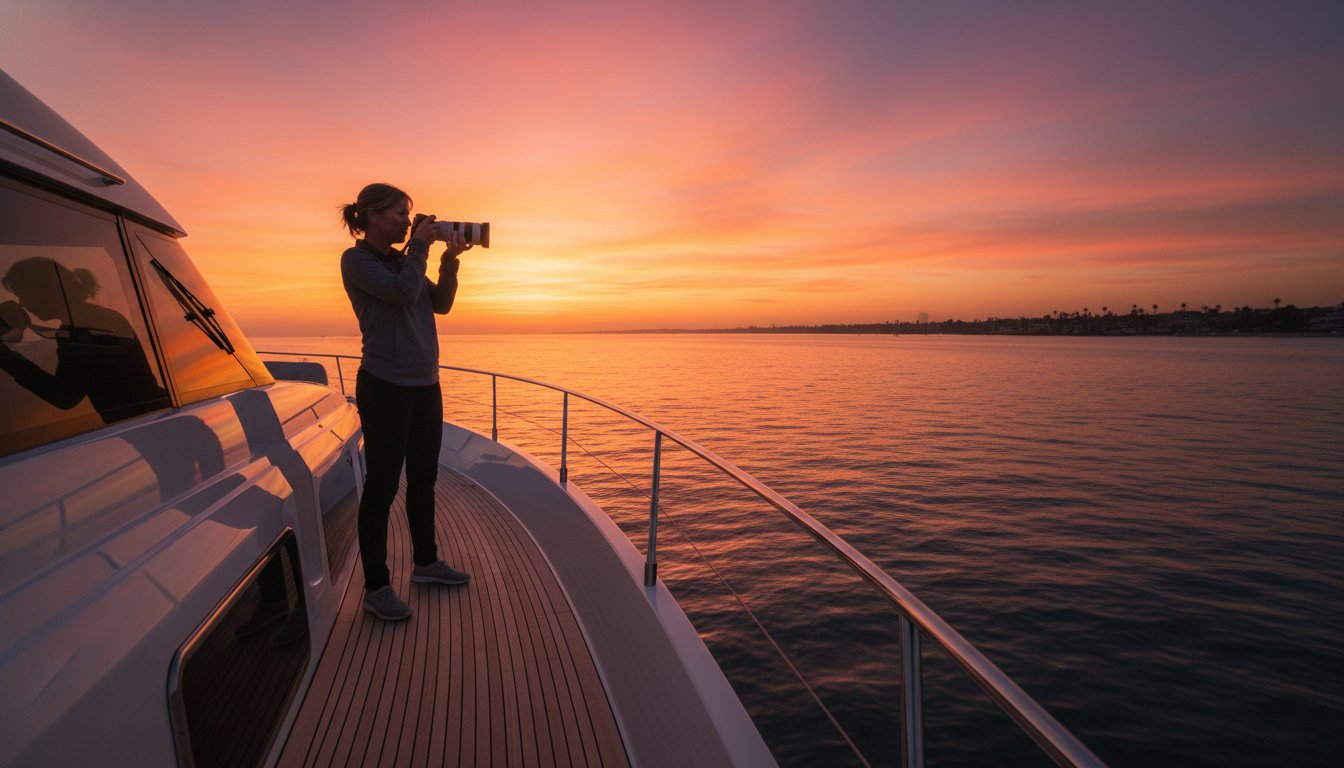
Imagine standing on the deck as the horizon ignites in shades of amber and violet, only to realize your camera is struggling to keep up with the gentle rhythm of the waves. It’s a common frustration for many photographers; you finally have the perfect view, but engine vibrations or tricky exposure levels leave you with blurry or dark images. On a crowded public tour, a stray elbow or a blocked railing can ruin your only chance at the perfect shot. These sunset cruise photography tips are designed to help you reclaim that moment and capture professional-grade images from the comfort of a private excursion.
You already know that the golden hour provides the most beautiful light of the day, but shooting from a moving vessel adds a layer of complexity that requires a specialized approach. We’ll guide you through the best camera settings for the water, including how to manage your shutter speed to counter boat motion. You will learn how to use the boat’s unique features to frame your shots and how to handle the high contrast of a setting sun. From choosing the right lens to utilizing the latest gear like a DJI Mavic 4 Pro for aerial perspectives, this guide ensures your next private cruise results in a gallery of stunning, sharp memories.
Key Takeaways
- Understand how light behaves differently on the water and how to utilize 360-degree reflections for more vibrant, luminous shots.
- Master the art of keeping your horizon perfectly level to ensure your maritime images look professional and polished.
- Apply these sunset cruise photography tips to balance your composition using the Rule of Thirds for striking silhouettes and sunlit vistas.
- Discover how a private Captain can position the vessel to provide you with the ultimate lighting angles without the interference of public crowds.
- Learn the specific camera settings required to eliminate blur from boat vibrations so you can capture sharp memories of your evening on the water.
Mastering the Golden Hour: Understanding Light and Motion on a Boat
Start your evening by embracing the soft, warm glow of the golden hour. This short window of time just before the sun sets provides the most flattering light for any coastal scene. On the water, you benefit from 360-degree reflections as the surface acts as a natural reflector, bouncing light back up to fill shadows and create a vibrant, luminous atmosphere that you simply cannot find on land.
To visualize how this light interacts with the horizon and surrounding scenery, watch this helpful video:
While the light is stunning, shooting from a private vessel presents unique challenges compared to stationary photography. Constant engine vibration and the rhythmic motion of the waves can easily lead to soft or blurry images if you aren’t prepared. Understanding these physical factors is a core part of our sunset cruise photography tips. Once the sun finally dips below the horizon, stay ready for the “Blue Hour,” which is the 20-minute period of deep indigo and violet light that follows the golden glow.
Timing Your Shoot for Maximum Impact
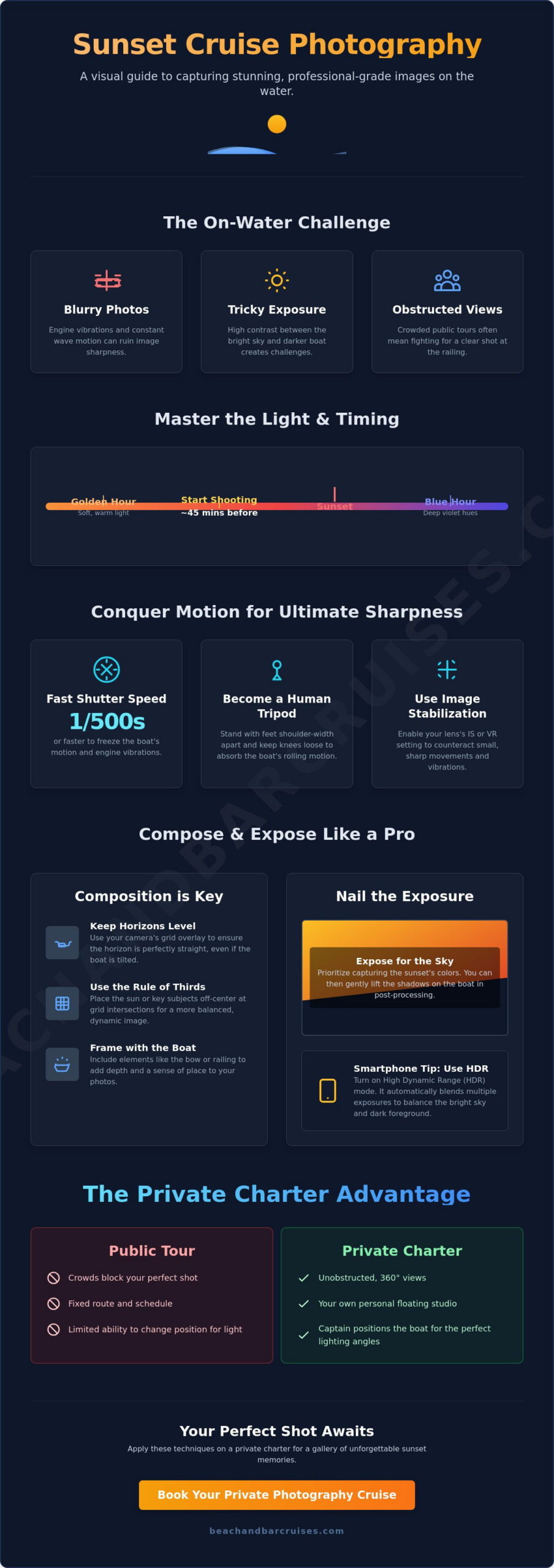
Experience shows that you should begin shooting at least 45 minutes before the actual sunset. This lead time allows you to capture the full spectrum of color changes as the sun descends. It’s essential to check local tide and sunset charts before you depart, as these variables dictate exactly where the best light will fall. Watching the transition from amber light to the moody purples of twilight provides a diverse range of shots for your final gallery.
Counteracting Boat Vibration and Swells
Keep your images sharp by setting a fast shutter speed, ideally at least 1/500s. This speed is usually enough to freeze both the engine’s hum and the boat’s movement over the swells. Become a “human tripod” by standing with your feet shoulder-width apart and keeping your knees loose; this allows your body to absorb the boat’s motion rather than transferring it to the camera. If your lens has Image Stabilization (IS) or Vibration Reduction (VR), keep it active to help steady the frame, though you should monitor your results to ensure the system isn’t overcompensating for the rolling water.
Essential Photography Techniques for Stunning Sunset Boat Photos
Capture the essence of your evening by following the golden rule of maritime photography: always keep your horizon line perfectly level. While the boat may tilt with the current, your camera shouldn’t. Using a grid overlay on your viewfinder helps you apply Essential Photography Techniques like the Rule of Thirds. Instead of placing the sun directly in the center, try positioning it at one of the intersections to create a more balanced, professional-looking image.
Managing dynamic range is often the biggest hurdle on the water. If you expose for the bright sky, your foreground becomes a dark silhouette; if you expose for the boat, the sunset loses its color. These sunset cruise photography tips suggest exposing for the sky and then gently lifting the shadows in post-processing. You can also add depth to your shots by including parts of the vessel. Framing your shot with the bow or the steering wheel provides a sense of place that makes the viewer feel like they are right there on the deck with you.
Composing with Water and Reflections
Look for the “glitter path,” which is the sun’s shimmering reflection stretching across the water toward your lens. This acts as a natural leading line that draws the eye directly into the sunset. If the air is exceptionally clear, stay alert for the “Green Flash,” a rare optical phenomenon that appears for a second at the very moment the sun disappears. Smartphone users should keep HDR mode active, as this helps the camera stitch together multiple exposures to handle the high-contrast lighting of a coastal evening.
Creative Silhouettes and Boat Framing
Dramatic silhouettes are easily achieved by positioning your subjects against the brightest part of the sky. Use the boat’s canopy or railings as a natural frame to enclose the sunset and add a touch of luxury to the composition. Beyond the landscape, don’t forget to capture candid “lifestyle” shots of your group enjoying a beverage or laughing together. These moments are best captured on a Sunset Cruise where you have the space and time to get every angle right without rushing.
Why a Private Charter is the Ultimate Sunset Photography Studio
Choosing a private vessel transforms the vast open water into your personal, curated photography studio. Unlike public tours with fixed routes and crowded decks, a private charter offers the flexibility to chase the light wherever it moves. If a bank of clouds shifts, your Captain can reposition the boat to ensure the sun remains perfectly framed within your lens. By applying our sunset cruise photography tips in this exclusive environment, you eliminate the stress of strangers blocking your view or bumping your arms during a critical exposure.
Stability is a major advantage of modern 21-foot hulls. These vessels provide a remarkably steady platform for photography, cutting through minor swells that might cause larger, top-heavy public ships to roll. This stability allows you to experiment with slightly slower shutter speeds if needed, though we still recommend staying above 1/500s for the sharpest results. Because you have the entire deck to yourself, you can move freely from bow to stern to capture 360-degree views without competition.
Collaborating with Your USCG Licensed Captain
Your experience is guided by a USCG licensed Captain who understands both the water and the needs of a photographer. Don’t hesitate to communicate your vision; a quick word can prompt the Captain to steady the boat or rotate the hull for a better angle. They provide an insider’s perspective, navigating to quiet, scenic inlets that public tours simply cannot reach. While the professional crew handles the technical boating terms and navigation, you are free to stay focused entirely on the horizon.
Planning Your Private Photography Excursion
Success on the water often comes down to packing light. A single versatile zoom lens, such as a 24-70mm or 24-105mm, is far more practical than a bag full of primes that require frequent changes in a breezy environment. Protect your investment by bringing a dedicated dry bag or a simple rain cover to shield your gear from salt spray and moisture. Ready to capture your own masterpiece? Book your private sunset cruise today and experience the golden hour from the best seat on the water.
Capture Your Masterpiece on the Water
Capturing the perfect sunset is a rewarding challenge that combines technical skill with the right environment. By applying these sunset cruise photography tips, you’ve learned how to manage shifting light, maintain a level horizon, and use the boat’s motion to your advantage. The difference between a good photo and a great one often comes down to the space and stability that only a private vessel can provide. When you aren’t fighting for a spot at the railing, you can focus entirely on the colors bleeding across the sky.
Our modern 21-foot Tidewater boat offers the ideal platform for your next creative outing. With a USCG Licensed Captain at the helm, you don’t have to worry about navigation or avoiding other passengers. These private tours for up to 6 guests ensure you have plenty of room to set up your gear and find the perfect angle as the sun dips below the horizon. It’s your time to relax, explore, and get the shot you’ve always wanted.
Book Your Private Sunset Cruise Experience today to see the coast from a new perspective. We can’t wait to see the stunning images you’ll bring home from your evening on the water.
Frequently Asked Questions
What is the best camera setting for a sunset cruise?
Manual mode or Aperture Priority is ideal for controlling how much light enters your lens as the sun dips. Set your aperture between f/8 and f/11 to ensure both the horizon and the boat stay in sharp focus. Use a “Cloudy” or “Shade” white balance setting to enhance the warm ambers and oranges of the sky. These sunset cruise photography tips help you maintain consistency as the light fades rapidly toward twilight.
Can I take good sunset photos with an iPhone or Android?
You can absolutely capture stunning images with a modern smartphone. Use the HDR setting to balance the bright sun with the darker water in the foreground. Tap and hold on the brightest part of the sky to lock your focus and then slide the exposure icon down slightly. This simple adjustment prevents the sunset from looking “blown out” and preserves the deep, rich colors of the coastal clouds.
How do I prevent my boat photos from being blurry?
Use burst mode to take several photos in quick succession. This technique significantly increases your chances of getting a crisp shot even if the boat hits a sudden wake. Avoid using a tripod on a private vessel because the legs will pick up every engine vibration directly from the deck. Instead, lean against a stable part of the hull and use your body to cushion the camera from the rhythmic motion of the water.
What should I bring on a sunset cruise for photography?
Pack a microfiber lens cloth to wipe away any salt spray that might cloud your glass during the trip. A circular polarizing filter is also helpful for cutting through the glare on the waves and making the colors of the water pop. Don’t forget a spare battery and a small dry bag to keep your gear safe from unexpected splashes while you put these sunset cruise photography tips into practice.
Article by
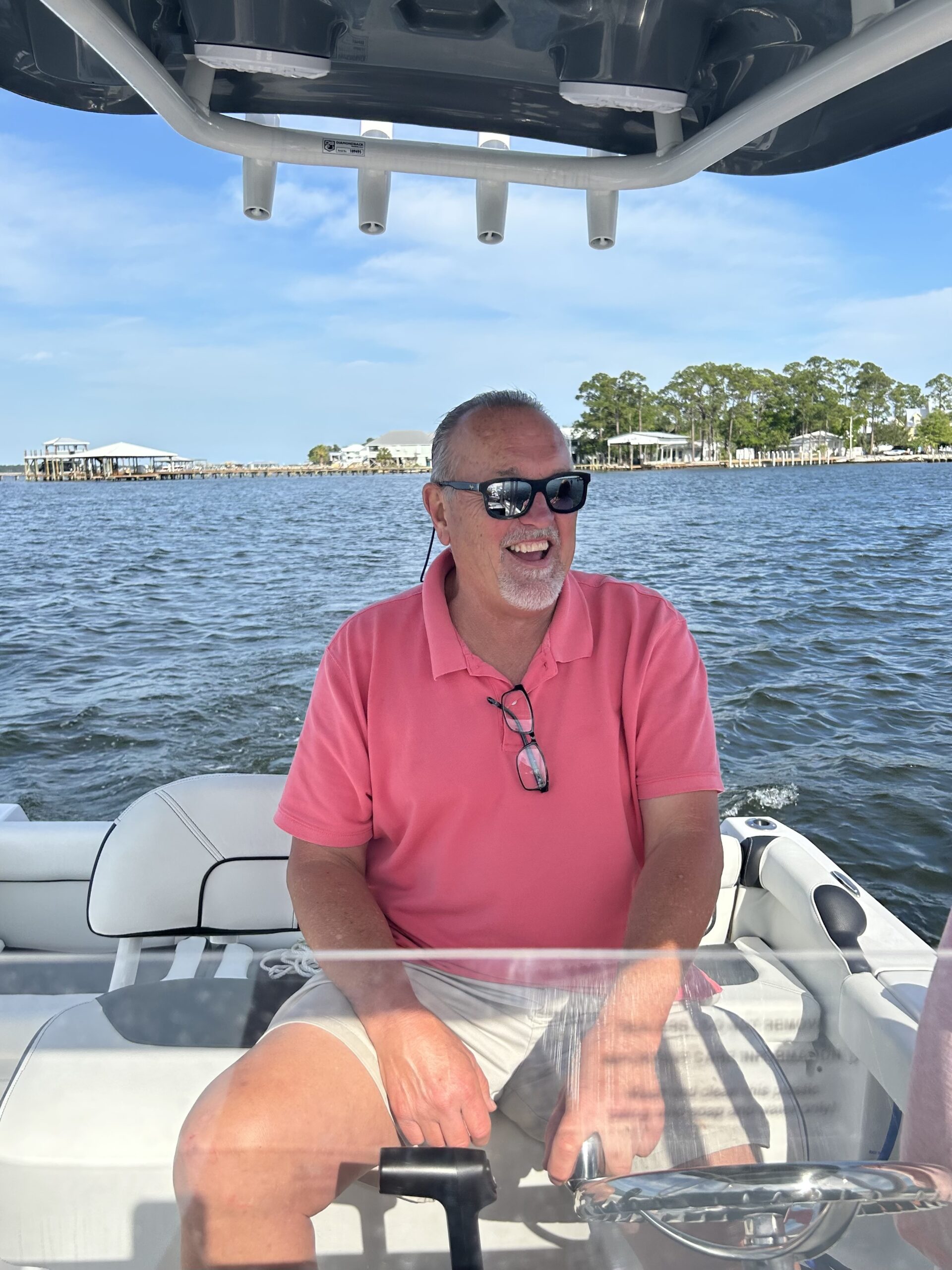
Captain Les
Captain Les has been operating boats for 40 years. The last 10 years have been in the waters around Orange Beach so he is very familiar with the waters and the area.